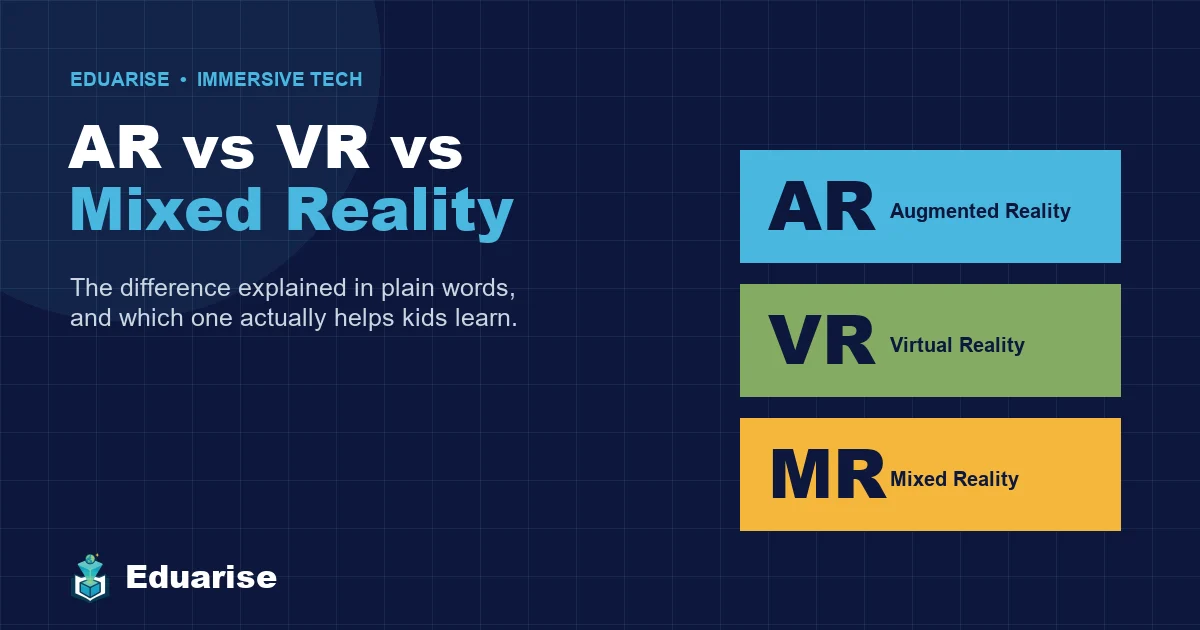
Three kinds of "reality", explained simply
Augmented reality, virtual reality, and mixed reality get used as if they mean the same thing. They do not. Each one changes how much of the real world you still see, and that single difference shapes what the technology is good for. Here is a plain guide, with a focus on what actually matters for learning.
What is augmented reality (AR)?
Augmented reality keeps you in the real world and adds digital things on top of it. You hold up a phone or tablet, point it at something real, and extra content appears layered over the live camera view. A printed map, for example, can sprout 3D countries, flags, and animals while the map itself stays on the table in front of you.
The key point is that AR adds to reality rather than replacing it. You still see the room, the table, and the people around you. That makes it comfortable, safe for young children, and easy to share, because everyone can look at the same real object together.
What is virtual reality (VR)?
Virtual reality replaces the real world entirely. You put on a headset that covers your eyes, and you are placed inside a fully digital environment. Look left and right and the whole scene moves with you. VR is powerful for stepping inside a place you could never visit, standing on the surface of Mars or inside a human cell, but it cuts you off from your surroundings.
For young children, that trade off matters. Headsets are heavier, more expensive, and can cause discomfort for some users. VR shines for older learners and specific training, less so for shared, everyday play.
What is mixed reality (MR)?
Mixed reality sits between the two. Like AR, it keeps the real world visible, but it goes a step further: digital objects are aware of the real space and can interact with it. A virtual model can sit on your actual desk, stay there as you walk around it, and respond to the real surfaces nearby. MR usually needs more advanced headsets or glasses, so it is still found mostly in industry and higher end education.
AR vs VR vs MR, side by side
- AR: real world visible, digital added on top, works on a normal phone. Best for shared, everyday learning.
- VR: real world replaced, fully digital, needs a headset. Best for deep, solo immersion.
- MR: real world visible and interactive with digital objects, needs special hardware. Best for hands on design and training.
Which one is best for children's learning?
For most families and classrooms, AR is the sweet spot. It runs on a phone you already own, it keeps children grounded in the real world, and it lets a parent or teacher explore alongside them. There is no headset to buy, no motion discomfort, and no child sealed off inside a screen. VR and MR have their place for older students and specialist tasks, but AR removes the barriers that keep the others out of everyday use.
This is exactly why the Eduarise AR World Map uses augmented reality rather than VR. A child points a phone at a printed map and the world comes alive in 3D, while the map stays on the table and the parent stays in the loop. You can see the full range here.
Frequently asked questions
Is AR the same as VR?
No. AR adds digital content on top of the real world you can still see. VR replaces the real world with a fully digital one using a headset.
Do I need a headset for AR?
No. Most AR runs on an ordinary phone or tablet. VR and mixed reality usually need a headset.
Which is safest for young children?
AR, because the child stays aware of their real surroundings and there is no headset. It is easy to share and comfortable for short sessions.