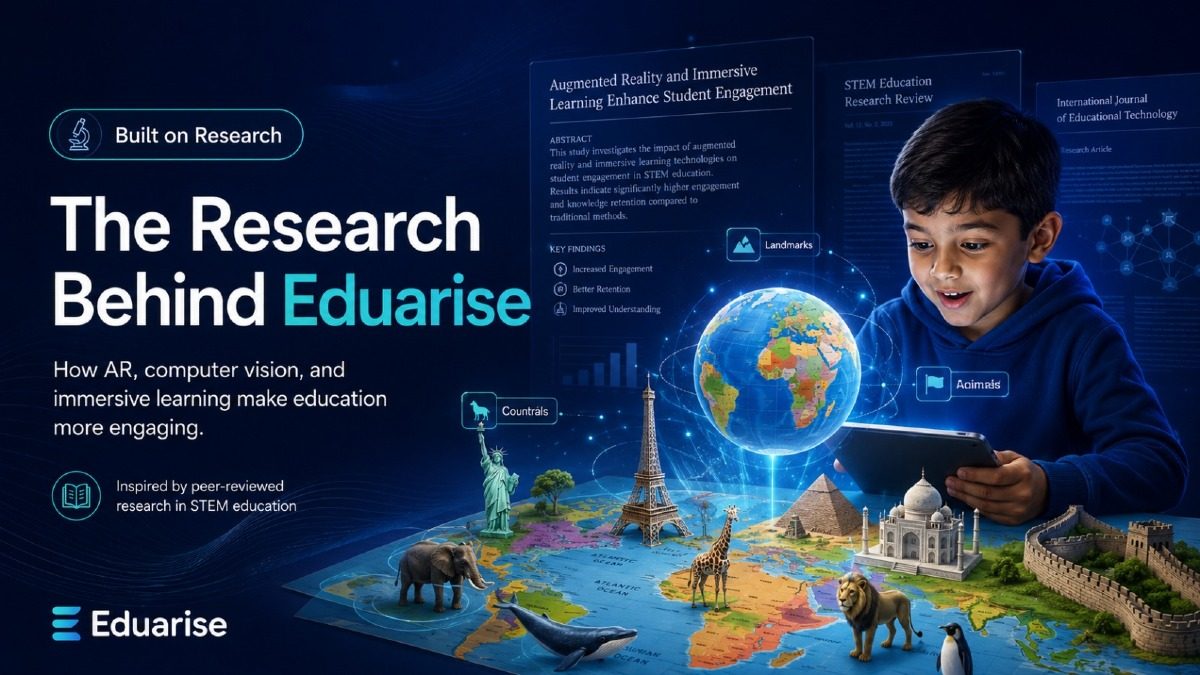
Learning Should Not Feel Flat
For decades, children have learned geography the same way: look at a map, memorize countries, repeat names, and hope the information stays in memory.
But children are naturally curious. They do not just want to read about the world. They want to see it, touch it, explore it, and ask questions about it.
That simple belief is what led to Eduarise.
Eduarise did not begin as just another educational toy brand. It started from a serious research question:
Can technology make learning more engaging, more immersive, and easier for children to understand?
That question became the foundation of a peer-reviewed research paper titled:
“Engagement detection and enhancement for STEM education through computer vision, augmented reality, and haptics.”
The paper was published in Image and Vision Computing by Elsevier and explored how computer vision, augmented reality, and haptic feedback could improve student engagement in STEM education.
You can read the full research paper here:
Read the full research paper on ScienceDirect
For Eduarise, this research was not just an academic milestone. It became the starting point of a mission:
To turn learning into an experience children can see, feel, and remember.
The Problem: Children Are Surrounded by Screens, But Not Always Learning
Parents today are not against technology. They are against empty screen time.
A child can spend hours on a tablet or phone and still learn almost nothing useful. That is the real problem. The issue is not the screen itself. The issue is what the screen is doing.
Is it distracting the child?
Or is it helping the child explore something meaningful?
The research behind Eduarise focused on student engagement because engagement is one of the biggest challenges in modern education. A child may be physically present in a classroom or online lesson, but mentally disconnected.
They may look like they are learning, but inside they may be bored, confused, or distracted.
That is why the research studied two important ideas together:
- Engagement detection
How can we understand whether a student is actually engaged? - Engagement enhancement
How can we design learning experiences that naturally make students more active, focused, and interested?
This is where computer vision, augmented reality, and haptics entered the picture.
What the Research Studied
The research combined three advanced technologies:
1. Computer Vision
Computer vision was used to detect student engagement by analyzing visual signals such as:
- Facial expressions
- Body posture
- Head movement
The idea was simple but powerful. If a student looks away, slouches, yawns, or shows signs of disengagement, technology can help educators understand that the learning experience may not be working.
This is important because traditional education often measures learning too late.
A quiz at the end tells you what a child remembered.
But engagement detection can help reveal what is happening during the learning process.
2. Augmented Reality
Augmented reality was used to bring learning content into the real world.
Instead of looking at a flat image of a country or landmark, students could scan a map and see digital 3D content appear on top of it.
This is exactly the kind of thinking that inspired the Eduarise AR World Map.
A map should not be just something children look at.
It should become a doorway.
A child scans the map, and suddenly the world becomes alive with countries, flags, animals, landmarks, wonders, sounds, quizzes, and interactive exploration.
That is the difference between passive learning and active discovery.
3. Haptics
Haptics means touch-based feedback.
In the research prototype, students could interact with famous landmarks using a haptic device. For example, instead of only seeing the Pyramid of Giza, students could experience a form of touch feedback through a specialized device.
This made the learning experience even more immersive.
Although haptic devices are not yet practical for every home or school because of cost and hardware limitations, the research showed something important:
The more senses involved in learning, the more engaging the experience can become.
Eduarise takes this idea forward by making immersive learning more accessible through mobile-based augmented reality.
Why the World Map Was Chosen
The research used a World Map because geography is one of the best subjects for visual and interactive learning.
A flat map can show where a country is.
But an AR map can help a child understand:
- What the country looks like
- Which animals live there
- Which landmarks are famous
- What the flag looks like
- What cultural or historical facts make it special
- How one place connects with the rest of the world
For children, this changes geography from memorization into exploration.
Instead of asking, “Where is Egypt?”
A child can ask:
“What is inside Egypt?”
“Why are the pyramids famous?”
“What animals live there?”
“What does the flag look like?”
“What makes this place different from mine?”
That is the kind of curiosity Eduarise wants to build.
What the Study Found
The research compared three learning methods:
- Traditional learning
- Augmented reality-based learning
- Haptics-based learning
A group of 30 children between the ages of 7 and 12 participated in the study. The students learned about the World Map through different methods and were then evaluated using recognized tools for measuring emotion, workload, and learning experience.
The results were clear:
Students showed stronger engagement with augmented reality and haptics-based learning than with traditional learning.
Traditional learning created a higher mental workload. In simple words, students had to work harder to stay focused and understand the material.
Augmented reality made the experience more visual, interactive, and exciting.
Haptics added an additional sense of immersion through touch.
The research showed that when learning becomes interactive, students are not just receiving information. They are participating in it.
And participation is where real learning begins.
How This Research Became Eduarise
Eduarise was built on the belief that children learn better when they are actively involved.
That is why the Eduarise AR World Map is not just a printed map.
It is a physical-plus-digital learning experience.
Children can hold a real map, scan it with the Eduarise app, and unlock interactive AR content. The experience brings together the best of both worlds:
The physical world:
A real map children can touch, place on a table, use in a classroom, or explore with parents.
The digital world:
3D models, country facts, landmarks, animals, quizzes, and interactive content that make the map come alive.
This matters because children do not need more random screen time.
They need better screen time.
Eduarise turns the screen into a learning tool, not a distraction.
Why AR Learning Works for Kids
Children are visual learners by nature.
They understand better when they can see a concept in front of them. This is why toys, models, drawings, and activities have always been powerful in early education.
Augmented reality takes that same principle and upgrades it.
Instead of only imagining a landmark, children can see it appear.
Instead of only reading a country name, they can interact with it.
Instead of only memorizing facts, they can discover them through play.
This creates three major benefits.
1. Learning Becomes Active
Children are not just watching. They are scanning, moving, tapping, answering, exploring, and asking questions.
Active learning keeps the brain involved.
2. Concepts Become Easier to Understand
A 3D landmark or animated object can explain something faster than a paragraph of text.
For young learners, visual context matters.
3. Screen Time Becomes Productive
Parents often worry about screen time because most digital content is passive.
Eduarise changes that by connecting the screen to a real educational object. The child is still using technology, but the purpose is learning, discovery, and interaction.
Built for Parents, Teachers, and Curious Children
The Eduarise AR World Map was designed for real homes and real classrooms.
Parents can use it to make learning fun at home.
Teachers can use it to make geography lessons more interactive.
Children can use it to explore the world independently.
This is especially useful for young learners who may find traditional geography boring or difficult to remember.
With Eduarise, learning becomes a moment of surprise:
A country is no longer just a shape on paper.
A landmark is no longer just a picture in a textbook.
A map is no longer just a map.
It becomes an experience.
From Research Lab to Real Learning
The original research explored a powerful future for education: a future where technology does not replace teachers, books, or physical learning materials, but enhances them.
That is exactly where Eduarise fits.
Eduarise is not trying to remove traditional learning.
It is making traditional learning more engaging.
A printed map still matters.
A teacher still matters.
A parent still matters.
But when AR is added, the learning experience becomes richer, more memorable, and more exciting for children.
That is the real vision.
Not technology for the sake of technology.
Technology for better learning.
The Future of Eduarise
The AR World Map is only the beginning.
Eduarise is building toward a future where children can learn through immersive educational products across geography, science, culture, history, and STEM.
The goal is to create learning experiences that are:
- Interactive
- Research-backed
- Child-friendly
- Parent-approved
- Classroom-ready
- Affordable and accessible
Because the future of education should not be limited to expensive labs or advanced hardware.
It should be available to children everywhere.
Final Thought
The research behind Eduarise proved something powerful:
When children can interact with what they are learning, they become more engaged.
Eduarise was born from that idea.
A map can be more than a map.
A screen can be more than entertainment.
A lesson can be more than memorization.
With the right design, learning can come alive.
That is the promise behind Eduarise.
Learning That Comes Alive.